
Credit Card Prosperity
Canada as the canary in the coal mine.

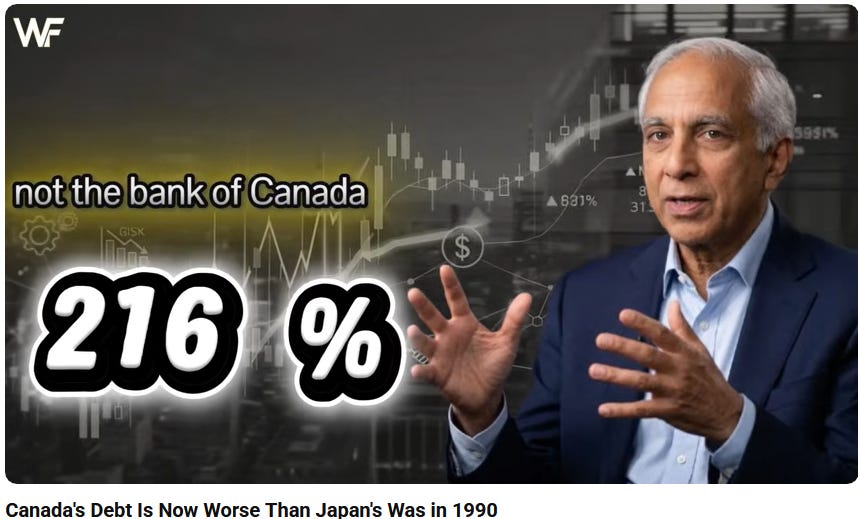
Canada’s private-debt-to-GDP ratio has now reached 216%. What that means is that individual Canadians collectively now owe - in mortgage, credit card card and line-of-credit debt - more than that twice the value of all the goods and services sold in Canada in an entire year. (Please note that this figure does not include the combined debts of Canada’s Federal and Provincial Governments - an additional 110% of GDP!)
For a point of reference, the Japanese economy collapsed in 1990 when Japan’s private-debt-to-GDP ratio stood at 214%, and the US economy collapsed in 2008 when America’s corresponding ratio stood at 175%.
There are two stories here. The first is that whatever mediocre economic growth Canada managed to achieve over the past decade was a false prosperity based on Canadians sliding deeper and deeper into debt.
I have a modest income as a pensioner, but my various credit card providers would quite happily loan me a total of about $35,000. (And this after my turning down various offers to raise my credit limits even higher!) My wife has a somewhat better income as an educational assistant, but a shorter credit history in Canada. I haven’t checked with her recently, but I suspect her credit limits are similar to mine. So our collective credit card limits are somewhere in the range of $70,000.
The two of us could look like we were rich for a number of years if we both gradually maxed out our credit cards - as a great many Canadians have been doing. (Interest rates kept artificially low have encouraged millions of Canadians to spend money they didn’t have!)
House prices in Canada were on an up escalator for many years. A great many Canadians bought houses and condos they couldn’t really afford because it would only get harder to buy the longer they waited. Until a couple of years ago, interest rates on those mortgages were low enough that it softened the pain.
All that said, appearing to be rich and being rich are not the same thing. What’s more, once your credit cards are maxed out - suddenly your ability to live beyond your means is drastically curtailed. That’s what happened in Japan in 1990, and that’s what happening in Canada today. That’s the second story - a false prosperity that is built on increasingly levels of debt eventually hits an end point.
It gets worse. When interest rates rise sharply - as they have done in recent months - Canadians’ minimum monthly credit card payments jump painfully too - so other spending must be cut back.
In Canada, unlike the United States, most mortgages are negotiated with 5-year fixed-rate terms. So millions of Canadians in the next few years will have to renew mortgages based on a 3% interest rate at something closer to 6%. Monthly payments they could only barely cover before, will then rise by 50% or more.
On top of that, forced sales and foreclosures are suddenly making it difficult or impossible for Canadians to sell a house they suddenly can no longer afford. Canada’s real estate escalator is now dropping sharply.
All of this goes a long way towards explaining why Canada saw negative GDP growth over the last quarter of 2025 and the first quarter of 2026 - a technical recession.
Canada is the canary in the coalmine. It’s private-debt-to-GDP level is the highest in the developed world. But other countries are also carrying unsustainable levels of private debt: in particular the US at 140%, Australia at 129%, and China at 198%.
The US stands out because it has unsustainable levels of BOTH public and private debt. Last year, the US Government had a deficit equivalent to 5.8% of GDP, Despite that, real US GDP grew by only 2.1% last year. Take away the money the US Government borrowed and the US economy would have shrunk by 2.7 percent last year. (David Stockman does a great job here in summarizing how unsustainable - and unfixable - the US Government debt situation has become.)
Add the worst oil shock in modern history to the above picture, and it could get really ugly.
PS: The other vulnerability is that almost half of US consumer spending comes from the richest 10% of Americans - often predicated on stock market gains. If the AI bubble pops, or if stock markets were to tank because the Iran War blew up again, the whole US economy would collapse like a house of cards.
The chickens are coming home to roost. I am SOOOO glad my wife and I paid off our mortgage and car loans years ago. Now it's just monthly utilities and we pay off the CCs each month. Now if I could only get healthy and stop seeing those damn doctors.....
Happy June, Bruce
Gosh, it’s almost like it’s intentional! Like we keep spending money that we don’t have so we borrow it from the central banks, who really don’t have it either, but they print up some more monopoly money and now we owe them interest on the money that they never had to begin with. I should have been a zionist banker.